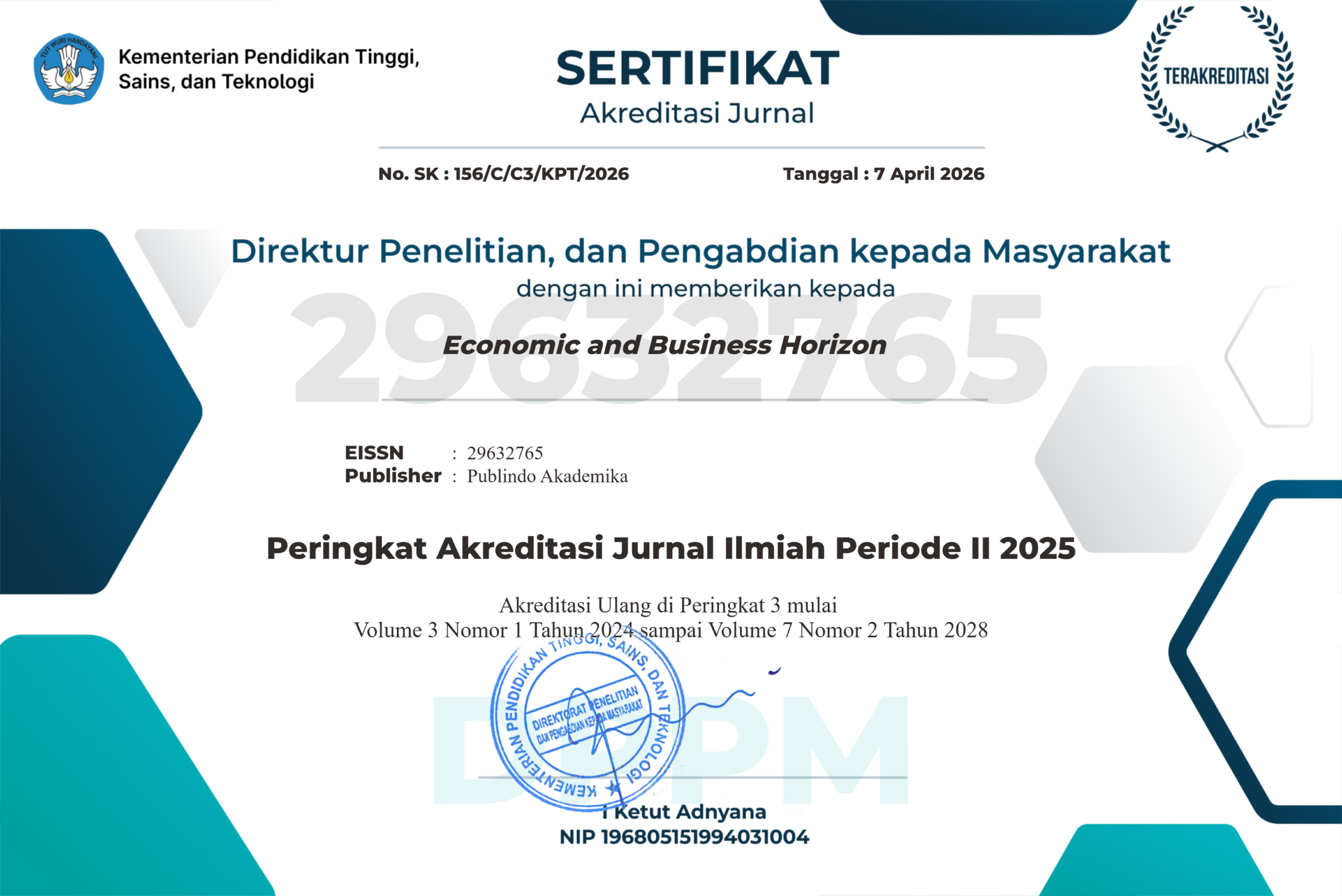
The Role of Financial Inclusion in Poverty Reduction: A Production Theory Approach
DOI:
https://doi.org/10.54518/ebh.1.1.2022.78Keywords:
Poverty, Financial Inclusion, Theory Production, Capital, Productivity IntroductionAbstract
This study attempts to analyze the role of financial inclusion in reducing poverty by using a production theory approach. This study used the production function as a function or equation that shows the relationship between the use of input combinations to produce the desired level of output in order to analyze the role of financial inclusion in reducing poverty. The results show that access to financial service products, especially loans, is used as capital input in community production activities. The community uses loans obtained from formal and informal financial institutions to increase their productivity through increased capital. Increased capital will increase output, so income will also increase.
References
Ali, A. (2021). Determining Mediating Role of Managerial Commitment and Technological Capability Between Environmental Management Accounting and Organisational Efficiency: A Case of Middle Eastern Countries. Arthatama, 5(2), 27-38.
Ali, A. E. S., Ali, K. M., & Khaleequzzaman, M. (eds.). (2020). Enhancing Financial Inclusion through Islamic Finance, Volume I. Palgrave Macmillan Cham
Anirwan, A., Ibrahim, M. A., Hasniati, H., & Lambali, S. (2021). Target Group Behavior for Policy Performance Impact: Study on Poverty Reduction Implementation in Makassar, Indonesia. Journal of Asian Multicultural Research for Social Sciences Study, 2(3), 33-39.
Ardic, O. P., Heimann, M., & Mylenko, N. (2011). Access to financial services and the financial inclusion agenda around the world: a cross-country analysis with a new data set. World Bank Policy Research Working Paper, (5537).
Atif, M. (2021). The Effects of Energy Consumption, Economic Growth, and Financial Development on CO2 Emissions in Greece. Arthatama, 5(1), 13-26.
Badan Pusat Statistik (BPS). (2012). Statistical Yearbook of Indonesia 2012. Jakarta: Badan Pusat Statistik (BPS).
Beck, T., & De La Torre, A. (2007). The basic analytics of access to financial services. Financial markets, institutions & instruments, 16(2), 79-117.
Claessens, S. (2006). Access to financial services: A review of the issues and public policy objectives. The World Bank Research Observer, 21(2), 207-240.
Kim, D. W., Yu, J. S., & Hassan, M. K. (2018). Financial inclusion and economic growth in OIC countries. Research in International Business and Finance, 43, 1-14.
Kurnia, H., Masbar, R., Sirojuzilam, & Zulham. (2022). Effect of regional planning on social welfare in the Islands and mainland of Aceh Province. Journal of Human Behavior in the Social Environment, 32(3), 356-374.
Majanga, B. (2016). The Journey to Financial Inclusion in Malawi-What Does the Future Hold?. International Journal Economics and Financial Research, 2(9), 169-175.
Manji, A. (2010). Eliminating poverty?‘Financial inclusion’, access to land, and gender equality in international development. The Modern Law Review, 73(6), 985-1004.
Masnita, Y., & Triyowati, H. (2019). Application of financial inclusions in Indonesia: A study on vulnerable group. Eurasian Journal of Economics and Finance, 7(3), 22-33.
Meiryani, M., Hanna Uli Pakpahan, N., Wahyuningtias, D., Mad Daud, Z., & Liawatimena, S. (2021, December). The Role of Financial Technology for Development of Micro, Small and Medium Enterprises (Msmes) in Indonesia. In 2021 the 11th International Conference on Communication and Network Security (pp. 60-65).
Mohan, R. (2006). Economic growth, financial deepening and financial inclusion. Reserve Bank of India Bulletin, 1305..
Park, C. Y., & Mercado, R. (2015). Financial inclusion, poverty, and income inequality in developing Asia. Asian Development Bank Economics Working Paper Series, (426).
Pindyck, R. S., Rubinfeld, D. L., & Rabasco, E. (2013). Microeconomia. Pearson Educación.
Rahayu, A. S., Hasanah, L. A. N., & Pratiwi, L. S. (2021). The Role of Financial Literacy in Reducing Poverty: Experience from Indonesia. Dinamika Ekonomi, 12(2), 133-141.
Rangarajan, C. (2008). Report of the committee on financial inclusion. Ministry of Finance, Government of India.
Ravallion, M. (1992). Poverty comparisons: A guide to concepts and methods. The World Bank.
Sharma, A., & Kukreja, S. (2013). An analytical study: Relevance of financial inclusion for developing nations. International journal of engineering and science, 2(6), 15-20.
Shephard, R. W. (2012). Cost and production functions (Vol. 194). Springer Science & Business Media.
Treasury, H. M. S. (2004). Promoting financial inclusion. London: HM Treasury.
United Nations Capital Development Fund. (2006). Building inclusive financial sectors for development. United Nations Publications.
Wahid, R. M., & Sarfiah, S. N. (2021). Analysis of Factors Affecting the Poverty Gap Index in Aceh Province 2017-2019. Research Horizon, 1(6), 217-228.
Yanescha, N. Y. P. (2022). Analysis of Factors Affecting Inflation in Indonesia 2015-2020: English. Research Horizon, 2(2), 330-344.

Downloads
Published
How to Cite
Issue
Section
License
Copyright (c) 2022 Economic and Business Horizon

This work is licensed under a Creative Commons Attribution-ShareAlike 4.0 International License.